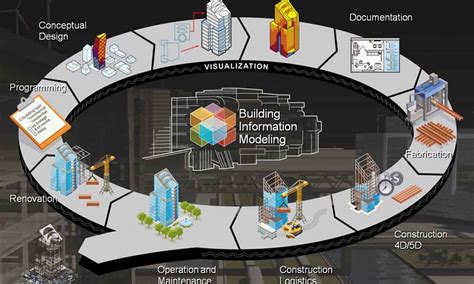
Why does connecting BIM with FM platforms matter today?
Because it closes the loop between design, construction, and operations. The as-built BIM model becomes a digital twin of the facility, containing critical information for operations and maintenance:
Equipment specifications and warranty information
Maintenance schedules and service history
Spare parts and supplier details
Space management and occupancy data
For asset-intensive facilities like data centers or hospitals with complex M&E systems, BIM-enabled facility management reduces operational costs and improves building performance.
Government agencies worldwide are adopting BIM for regulatory approval.
Enhanced collaboration: Keep all stakeholders aligned
BIM acts as a single source of truth. What are the main BIM dimensions (3D to 7D)?
3D: Geometric and spatial design
4D: Construction scheduling
5D: Cost estimation and budgeting
6D: Sustainability and energy performance
7D: Facility management and operational optimization
9.
However, with global BIM mandates accelerating (Singapore CORENET X, Netherlands, Australia), contractors who delay adoption risk being locked out of major projects. What are the benefits of integrating BIM with CAFM or CMMS?
Centralized access to all building and asset data.
Automated maintenance scheduling and task tracking.
Accurate asset information for better planning and budgeting.
Visual access to asset location and condition through 3D models.
Improved collaboration between design, operations, and maintenance teams.
5.
How does BIM help with preventive and predictive maintenance?
When linked with CMMS or CAFM, BIM data provides full visibility into asset conditions and histories. Each component carries data about its size, material, and performance, creating an intelligent model that supports design, analysis, and maintenance decisions.
2.
Each asset comes with its specifications, performance data, and maintenance records, all accessible directly from the model. Too much detail upfront wastes time on elements that may change. OpenBIM standards like IFC 4x3 now support infrastructure projects (bridges, tunnels, rail), enabling seamless data exchange across software platforms and preserving project data throughout the asset lifecycle.
BIM is short for Building Information Modeling, and it represents a data-rich 3D representation of a physical asset.
Whether you need full-service BIM coordination, model conversion from 2D, or trained BIM personnel for specific projects, outsourcing provides BIM capabilities without the overhead of permanent staff and software investments.
As BIM technology continues to evolve—with AI, cloud platforms, and web-based tools—the industry's digital transformation will only accelerate.
Asset-heavy industries and infrastructure operators
Monitor critical systems (like HVAC, MEP, and safety equipment) in real time.
Anticipate failures through predictive analytics.
Maintain compliance and operational reliability across large, complex sites.
Why it matters: Use BIM-driven FM data to boost uptime, reliability, and compliance across complex infrastructures.
5.
Benefits of Levels 4, 5, and 6 BIM:
More efficient site planning and scheduling
More efficient hand-offs between steps in the construction stage
Real-time cost visualization
Simplified cost analysis
Reduced energy consumption in the long run
Better operational management of the building or structure after handover
The future of BIM
Because of the clear benefits, BIM is here to stay.
It has defined goals and objectives that are clearly beneficial to all those who work their way through the levels.
However, with global BIM mandates accelerating, this is changing—contractors who delay adoption risk being locked out of major projects.
This is where BIM service providers add value. When working at this level of BIM, project owners can track and determine what costs will be incurred during the length of the project.
Today, most of the industry is working above this level, although not every professional in the industry has sufficient BIM training and some projects do not include the use of BIM in contract specifications.
Level 1 BIM: 2D construction drawings + some 3D modeling
Using 3D CAD for concept work, but 2D for drafting production information and other documentation, probably means you're working Level 1 BIM.
At this level, CAD standards are managed to the standard of BS 1192:2007, and electronic sharing of data carried out from a common data environment (CDE) usually managed by the contractor. It catches clashes before construction, facilitates real-time collaboration, and ensures regulatory compliance with digital submission requirements. Facility teams can analyze asset performance, predict failures before they occur, and schedule service at the best possible time, keeping downtime and disruptions to a minimum.
3.
It’s the most practical, scalable, and dependable way to extend BIM beyond construction, ensuring every facility operates at peak performance throughout its lifecycle.
And the industry agrees. This ensures version control, reduces errors, and eliminates disconnected information silos.
🏢
What is Common Data Environment (CDE)? A Common Data Environment is a shared digital space where all project information—designs, documents, and models—is stored, managed, and updated in real time.
It significantly shortens review cycles and improves coordination among design and construction teams.
2. Since data is shared this way, the CAD software must be capable of exporting to a common file format, such as IFC (Industry Foundation Class) or COBie (Construction Operations Building Information Exchange).
Level 3 BIM: teams work with a shared 3D model
BIM level 3 is even more collaborative.
Facilio was recognized in the 2025 Verdantix Green Quadrant for Commercial CMMS, placing it among the most capable and forward-thinking platforms globally.
However, the way in which stakeholders exchange information differentiates it from other levels.